
Breast Cancer by the Numbers
What 2026 Actually Looks Like
Every October we get a lot of pink. Ribbons, campaigns, storefronts, everybody posting.
What we don't get as much of are the actual numbers, and honestly those are the part that might change what you do this week.
So I looked them up. Here's where things stand in 2026, and what I think is worth paying attention to.
First, the scale of it
This year, around 321,910 women in the U.S. will be diagnosed with invasive breast cancer. Another 60,730 will be diagnosed with DCIS, which is a non-invasive form. About 42,140 women will die from it.
Roughly 1 in 8 women will develop invasive breast cancer in her lifetime.
Numbers that big kind of stop meaning anything, so here's how I think about it instead. Picture the women in your own life. Your mom, your sisters, your girlfriends, the women you work with. Statistically one of them is going to deal with this.
That's the part that gets me.
Hold on, invasive versus non-invasive. What does that even mean?
I throw these words around and I realized most people have no idea what they actually mean. So let me back up, because the difference matters a lot.
Think of your milk ducts like tiny straws running through your breast tissue.
Non-invasive means the abnormal cells are still inside the straw. They've shown up, they're growing, but they haven't broken through the wall. The medical term is "in situ," which just means "in its original place." The most common kind is DCIS, ductal carcinoma in situ, and it's considered stage 0.
Because those cells are still contained, DCIS can't spread to the rest of your body while it stays that way. It's still treated, though, and here's why: nobody can reliably predict which cases would eventually break through and which wouldn't. So it gets handled early rather than gambled on.
Invasive means the cells broke through the wall of the straw and got out into the surrounding breast tissue.
That's the part that changes everything. Once cells are loose in the tissue, they can get into your lymphatic system or your bloodstream, and from there they can travel. The lymph nodes under your arm are usually the first stop.
About 70 to 80% of invasive cases start in the ducts. Another 10 to 15% start in the lobules, the little glands that actually produce milk.
So when you hear "invasive," it's not describing how aggressive the treatment will be or how scary the cancer is. It's describing one specific thing: did the cells stay put, or did they get out.
That's it. That's the whole distinction.
The one I really want you to hear
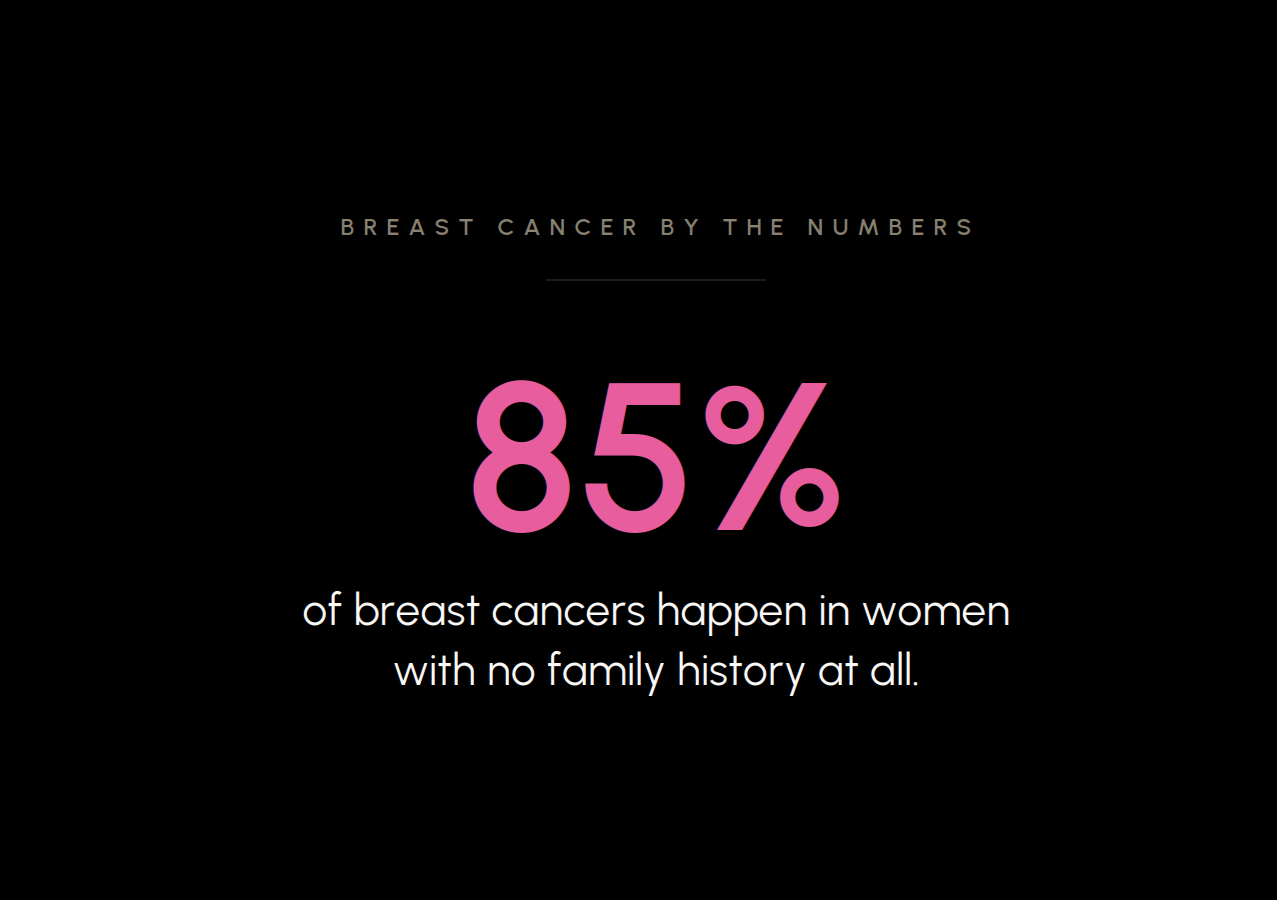
About 85% of breast cancers happen in women with no family history at all.
I bring this one up constantly because so many people have quietly decided they're fine. Nobody in my family had it, so I'm probably good.
Eighty-five percent. The vast majority of women who get diagnosed had no reason to see it coming.
Family history raises your risk, sure. But not having it doesn't protect you. It just isn't the shield people think it is.
Men, this includes you
In 2026, about 2,670 men will be diagnosed with invasive breast cancer and around 530 will die from it.
Small number compared to women, which is exactly what makes it dangerous. Men don't get screened. Nobody tells them to check. And when they do speak up, it often gets brushed off as a cyst or a pulled muscle.
If you have breast tissue, you can get breast cancer. That's it. That's the whole rule.
Age matters, just not the way people assume
Median age at diagnosis is 64, so yes, risk goes up as you get older.
But about 16% of women diagnosed are under 50. That's roughly one in six.
I need to tell you about my best friend Andrea.
She was diagnosed at 36. Stage 4. She passed away a week after her 39th birthday.
Thirty-six. That's the number that sits with me every single time I hear someone say they're too young to worry about this. Andrea was too young too. It didn't matter.
I'm not telling you that to scare you. I'm telling you because when I say don't wait, don't let yourself get brushed off, don't assume you're fine just because of your age, I'm not saying it as some general piece of advice. I'm saying it because I lost her.
I hear the same story over and over. Someone noticed something, brought it up, got told she was too young to worry about it. And then months went by.
If something feels off in your body, your age is not a reason to wait it out.
Okay, now the hopeful part
This is where the numbers actually get good.
Overall 5-year survival for breast cancer is 91.9%. But look at what happens when you break it down by how early it was caught:
Localized, still in the breast: 100%
Regional, spread to nearby tissue: 87.5%
Distant, spread further in the body: 33.8%
That right there is the entire argument for screening. Catch it early and survival is basically the same as anyone else's. Catch it late and it's about one in three.
Right now 64% of cases are caught while still localized. Which also means more than a third aren't.
What screening looks like now
The guidelines changed, and a lot of people haven't caught up.
Current recommendation from the U.S. Preventive Services Task Force: mammograms every other year, starting at 40, through age 74.
That's a real shift. The old guidance basically told women in their forties to figure it out with their doctor. Now it just says start at 40.
If you've got family history, dense breast tissue, genetic risk, anything like that, your doctor might want you starting earlier or going more often. Have that conversation instead of assuming the standard applies to you.
What you can actually do
Know your own normal. You don't need a whole formal routine. Just be familiar enough with your body that you'd notice if something changed.
Know what you're looking for. Everybody knows "lump," but also watch for dimpling or puckering in the skin, nipple changes or inversion, unusual discharge, redness that won't go away, swelling, or skin that looks sort of like an orange peel.
Don't let yourself get brushed off. If something feels wrong and you're being dismissed, push. Ask for imaging. Get another opinion. The gap between noticing something and getting it looked at is one of the only parts of this you actually control.
Get the mammogram. At 40 if you're average risk, sooner if your doctor says so.
Why I care about this so much
My work happens at the very end of all of this. By the time someone's sitting in my chair for areola and nipple restoration, she's already been through the diagnosis, the surgery, the treatment, the reconstruction. All of it.
I don't get to change any of that. I just get the last piece.
But I'll tell you what I've noticed. The women who caught it early come to me tired in a completely different way than the women who caught it late. Early detection shapes everything that comes after it.
And I care because of Andrea.
So this month, just do the thing you've been putting off. Schedule the mammogram. Make the appointment about the thing that's been nagging at you since summer. Tell the women you love to do the same.
And if you're already on the other side of it and starting to think about what's next, I'm here whenever you're ready.
